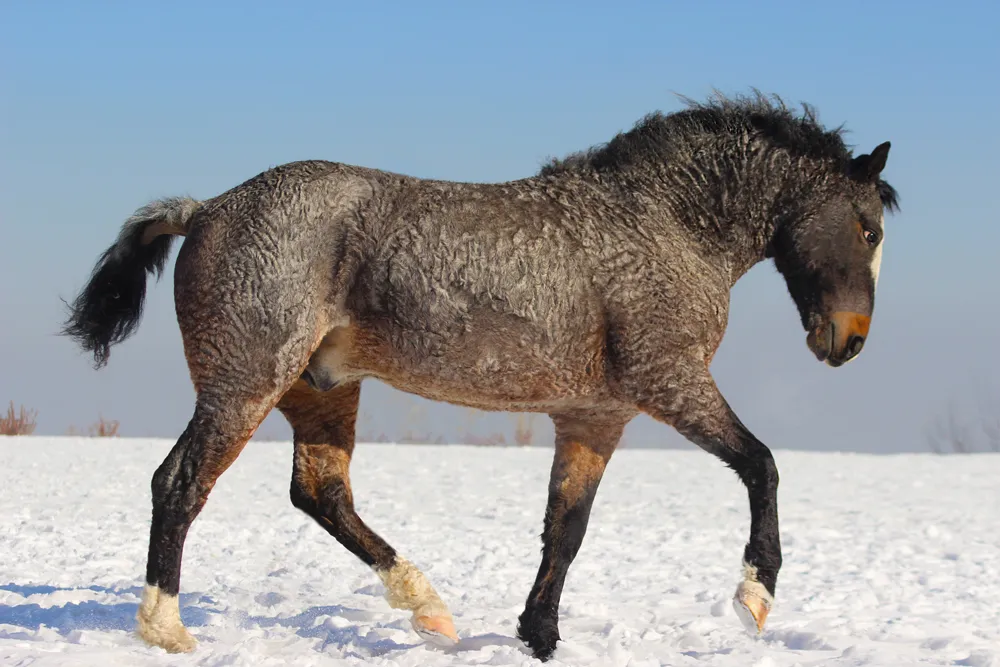
The American Bashkir Curly is the horse world’s oddest and most endearing puzzle: a breed defined by a coat of ringlets — mane, body, even the inside of the ears — and a reputation, hotly debated, as the one horse allergy sufferers can ride. Add a calm-to-a-fault temperament and iron hardiness, and you have a genuine American original whose origins nobody can fully explain.
Here’s the field file: the mystery history, the truth about the allergy claim, and what it’s like to own the curliest horse alive.
History & Origin
The modern breed traces to 1898, when Peter Damele and his father spotted three curly-coated horses running wild in the mountains of central Nevada. The Damele family bred them — adding Morgan and Arabian blood along the way — and most American Curlies alive today descend from that herd. The registry followed in 1971.
Everything before Nevada is contested. Curly-coated horses appear in Sioux winter counts from 1801–1802, in Chinese art, and in scattered records worldwide, but no land bridge or migration explains how they reached North America. The "Bashkir" name is almost certainly a red herring: it was borrowed after a 1938 magazine featured a curly horse from Bashkortostan, Russia — a breed the American Curly shares no proven ancestry with. Modern genetics traces the curl to mutations in two genes, KRT25 and SP6, which can arise independently, meaning the world's curly horses may not share a single origin at all.
Range
Temperament & Handling
If one word follows this breed everywhere, it's unflappable. Curlies are prized for a calm, people-oriented disposition — quick to learn, hard to rattle, and forgiving of mistakes. Owners routinely describe them as the horse that stays sensible when everything else spooks.
That temperament, paired with their easy-keeper hardiness, makes them a standout family and first-horse candidate. They bond readily with people and tend to try hard, which is exactly the combination a nervous or novice rider needs underneath them.
Care & Management
Curlies are textbook easy keepers — desert-forged, weatherproof, and efficient on modest forage. They hold condition where other breeds need groceries, which flips into the usual caution: watch the waistline on rich pasture, since metabolic problems are the easy-keeper's real risk.
The coat is the one genuinely unusual care note. Those curls shed dramatically — many Curlies drop their mane and tail hair each summer and regrow the ringlets in fall — so grooming rhythms differ from a straight-coated horse. Otherwise, hardy feet and a hardy constitution keep upkeep low.
Health & Lifespan
The Curly is a relatively healthy breed with no widespread breed-specific disease, and its coat mutation — unlike curl-linked problems in some other animals — is normal and benign. Lifespans run long, and the constitution is robust.
The honest health headline is the allergy question. Many riders with horse allergies genuinely report few or no symptoms around Curlies, and small studies have documented allergic riders tolerating them; some research even suggests regular Curly contact can build tolerance to other horses. But a 2024 proteomic analysis found Curly hair carries the major horse allergen Equ c 1 at levels comparable to other breeds — no molecular basis for a truly "hypoallergenic" horse. The fair summary: many allergic people do fine with Curlies, but the science doesn't yet explain why, and no allergic rider should assume immunity without testing their own reaction first.
Uses & Disciplines
Versatility is the Curly's calling card. The calm head and willing mind suit them to trail and pleasure riding, ranch work, driving, and family mounts — anywhere temperament matters more than specialization.
They've also found a foothold in sport. Curly Sporthorse International promotes the breed in dressage and other disciplines, and crossbred Curly Sport Horses compete in awards programs. They're not a specialist's speed or jumping machine, but as an all-around amateur partner — especially for riders who need that unshakeable disposition — they punch well above their rarity.
Buying & Ownership Costs
As a rare breed, Curlies aren't found on every sale barn's roster, but an active North American registry and breeder network make them more attainable than most endangered horses. Expect pricing in the low-to-mid four figures for young or grade stock and higher for trained, registered, or proven allergy-friendly individuals — the allergy reputation itself commands a premium among buyers who need it.
Before buying: confirm registration through the American Bashkir Curly Registry or a recognized Curly association, and if allergies are your reason for the breed, spend real time with the specific horse before committing — individual reactions vary, and the breed-wide claim is not a guarantee for any one animal.
Fun Facts
- The curl comes from mutations in two genes, KRT25 and SP6 — and can appear spontaneously in other breeds.
- Many Curlies shed their mane and tail entirely each summer, regrowing the ringlets when cold weather returns.
- The "Bashkir" name is likely a mistake, borrowed from a 1938 magazine photo of an unrelated Russian horse.
- Curly-coated horses show up in Sioux winter counts from 1801–1802, long before the breed was formally recognized.
- They have curls even inside their ears, and often a distinctive mane that splits and falls down both sides of the neck.
Sources
- Mad Barn — American Bashkir Curly Horse Breed Profile
- FEI — Breed Profile: American Bashkir Curly Horse
- Janssen-Weets et al. (2024), Clinical & Translational Allergy — proteomic allergen analysis
- The Equinest — American Curly
FAQ
Are Curly Horses really hypoallergenic?
Many horse-allergic riders report few or no symptoms around Curlies, and small studies have documented allergic riders tolerating them. But a 2024 proteomic study found their hair carries the major horse allergen at normal levels. Bottom line: many allergic people do fine with them, but test your own reaction to the specific horse before relying on it.
Why is it called Bashkir if it is not Russian?
The name was borrowed after a 1938 magazine featured a curly horse from Bashkortostan, Russia. The American Curly has no proven ancestry with that horse u2014 the name simply stuck.
Where did Curly Horses come from?
The modern breed traces to three curly horses found running wild in Nevada in 1898 by the Damele family. Their deeper origin is genuinely unknown u2014 curly horses appear in records worldwide with no clear migration path to North America.
Are Curly Horses good for beginners?
Yes u2014 they are famous for a calm, unflappable, people-oriented temperament and easy-keeper hardiness, which makes them a strong first-horse and family choice.
What happens to a Curly coat in summer?
It largely disappears. The curl is most pronounced in the winter coat; many Curlies shed out to a nearly straight summer coat, keeping curl only in the mane, forelock, and inside the ears. Some also shed mane and tail hair seasonally, which is normal for the breed and not a sign of illness.


